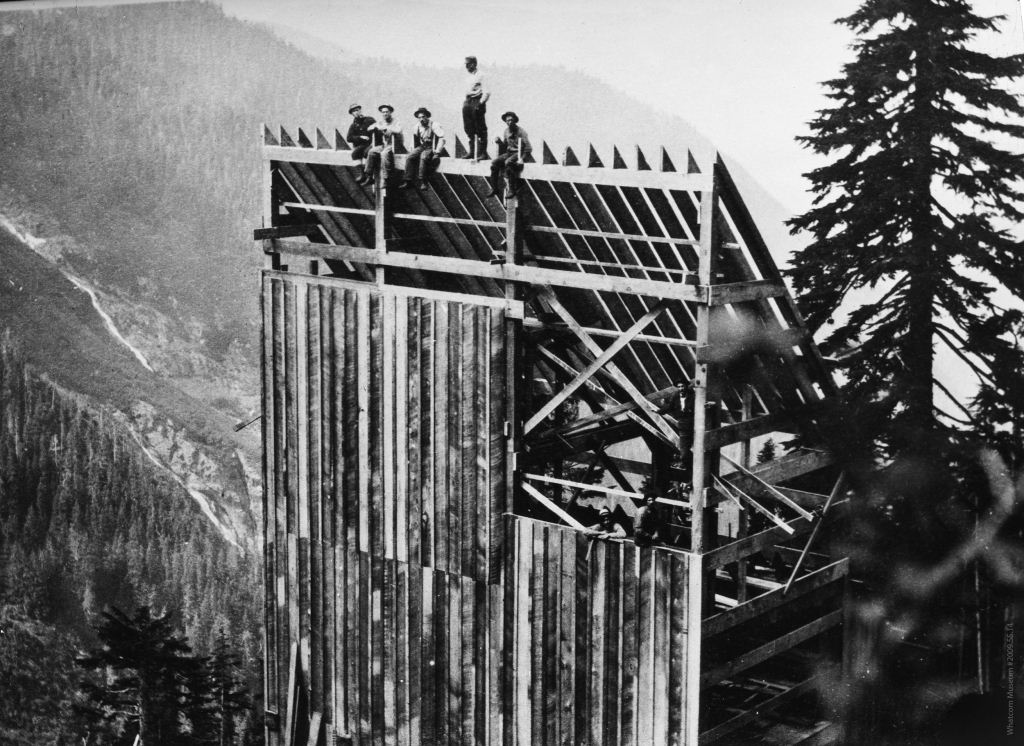
The Grand View Mine was first worked for gold, it's estimated that around 1870-1874 the mines had been worked by prospectors for the native gold deposits. The gold ran with scheelite. Scheelite is a calcium tungstate mineral with the chemical formula CaWO4. It is an important indicator of native gold deposits. The Fluorescence of scheelite is usually indicative of an association with native gold. While scheelite has no economic value, it is used by geologists in the search for gold deposits. It is assumed that with the silver crash and general depression in mining around 1893, the mines were abandoned and forgotten.
The Grand View Mine was again worked from 1927 to 1939 when a group of indigent prospectors from back east came to the mines seeking reprieve from the great Depression. The cabins that had been built in support of the previous mining operation were utilized over the cold winter while the miners blocked out large deposits of gold ore.
With the War Act, the mine was again abandoned. When the War Act was repealed there was a federal bounty being paid for tungsten. Tungsten was used to harden steel and a vital part of national defense. Many unscrupulous prospectors and ranchers began locating old gold mines as Tungsten mines. Tungsten and scheelite are often found in great quantities in gold mines. If the mine was located as a tungsten mine, the locator could expect a federal payment of at least $5000.00 without having to ship any ore. This program was short lived due to the amount of fraud that was perpetrated, but it left many of the old Gold mines across the West improperly labeled as tungsten mines.
The Grand View Mine is just such a site. With visible gold deposits inside, the mine never produced a single gram of Tungsten. The incorrect and unverified history was recorded by some poor fool in 1943 as follows:
The Grand View claims are on the west slope of the Snake Range about 15 miles north of Sacramento Pass...They are reached from paved U. S. Highway 6 by following the graded dirt road along the east side of Spring Valley for 15 miles north of Sacramento Pass to a point 1.4 mile south of the Eldredge Ranch, then turning east for 5 miles up an unimproved road. From the end of this road, the claims are a mile by indistinct trail that goes over the ridge to the south into the next canyon.
The 4 unpatented claims were located by Wm. W Choate on July 10, 1943 in the name of the Black Mountain Mining Co. of Delle, Utah. This company is a limited partnership of about 25 people, with Wm. W. Choate as general partner in control. The scheelite occurrence was first discovered by an Indian named Chidester, who works for Choate.[1]
Mr. Dwight Lemmon further goes on to state that there is no tungsten of any value and the only interesting aspect of the claim is a quartz vein with heavy galena. To make matters more confusing. There was never any scheelite of any substance discovered at the claim. The district and the mines are reported as being worked for gold, silver, copper, and lead.[2]