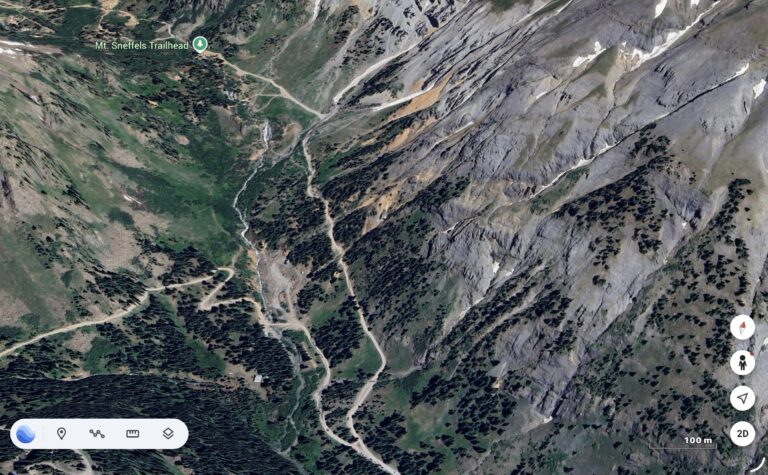
The first recorded activity on the site was in 1870, records of patenting of claims were surveyed and patented in those years.
1870 - 1902
The principal workings were the Minnie B, Trust Ruby and the Circassian veins. These veins produced approximately 4000 ounces of Gold and 80,000 ounces of silver. The ore was processed at the Yankee Boy, Ruby Trust twenty stamp mill.
The Minnie B tunnel and shaft were driven on the Ruby Trust vein. The upper levels (near surface) of the Ruby Trust vein were a silver rich sulphide vein with minor gold ( approx. 20 oz of silver were produced for each oz of gold). As mining proceed to depth the secondary enriched silver zone was replaced by primary mineral silver gold zone.
The Circassian vein production occurred (1886-1892). Some 20,000 tons of .50 to 1.00 oz / ton gold and 80 oz / ton silver were mined from a shoot, at places 30 ft wide.
Mining activity was discontinued in 1902 due to the fact that the mill was destroyed by an avalanche and was not rebuilt.
NOTE: Recent drilling and sampling of the Ruby Trust west track level revealed a 5-10 oz/ton silver grade and .50 oz/ton gold with 3-5% combined base metals of lead, copper and zinc.
1925 - 1948
The next period of mining activity the Ruby Trust claims were leased out during this interval and the mining was done by individual leasers. Total tonnage removed and milled was 1700 tons. From this ore, 390 ounces of gold and 2500 ounces of silver successfully extracted. A avalanche took out the Minnie B stamp mill in 1948 and the mine was abandoned.
From 1948 to the early 1980’s, no mining occurred on the Ruby Trust.
1978 - 1985
During this time the property was sold to current owner. The decline access was developed in 1980. Early 1980’s, approximately 5200 tons of ore were mined. To mill the ore an above ground processing plant was erected in 1984/1985. This mill was destroyed shortly after construction. All ore processing ceased after the destruction.
2007 - 2010
In 2007 the Ruby Trust mine was sold to an investment group (green to the mining industry). During 2009 a small stope was mined on the decline level (100 ft below mill level). This stope produced 685 tons of .50 oz/ton gold and 10 oz/ton silver. This ore was milled through a 50 ton/day mill on location at the Ruby Trust. Approximately 200 tons were milled. The mill was set up with a jaw crusher, cone crusher and ball mill. 2.44 tons of concentrates were collected and processed.
These concentrates were shipped to Metals Research Corp. in Kimberly, Idaho. The head assays for this shipment showed 74.2 oz of Gold and 95 oz of silver were present in these concentrations. Because of grinding problems at the Ruby Trust mill, over 60% of the gold and 80% of the silver in this 200 tons was sent to tailings. These tailing are still underground at the Ruby Trust and can be recovered. The important point is, if calculated back, the head grade would be .93 oz/ton gold and 2.38 oz/ton silver.
Because of onsite milling problems, 400 tons of ore were shipped to Kenross Gold Mill in Kettle Falls, Washington in 2010. The final results of the milling showed a head grade of .338 oz/ton with 88% recovery, silver was not recovered at this mill. 107.741 gold ounces paid according to settlement sheet.
Due to contract default and disputes among partners, property was taken back by previous owner. (Previous owner held note on the purchase).
2012
A drilling program in 2012 (full report available, as well as cores) to unexplored areas to the east of the existing workings, in the vicinity of the projections to the Bessie Bascom, encountered several veins with significant mineralization. Multi-ounce gold assays were reported. These values interested an individual to purchase the Ruby Trust property.
2016 -2018
The Ruby Trust property was purchased by an investor from Texas. ( green to the mining industry). The 2012 drilling program prompted to drive a 1000 ft crosscut drift to intersect the primary vein found in report. The vein has been intersected and is accessible by the crosscut and contains considerable mineralization. Due to limited survey control the highest grade intersections may be 60 ft above the cross cut intersection. This is an area that warrants exploration drilling from cross cut to evaluate defined vein targets.
Due to contract default the property was taken back by (Previous owner held note on the purchase).