
Gold mining properties in Peru – Qincemil
Gold mining properties in Peru - Qince Mil
Property Details
| Location | Peru |
|---|---|
| Address | {-13.23591,-70.74432} |
| Commodities | Gold |
| Deposit Type | Other |
| Mining Phase | Exploration |
| Asking Price | 850000 |
| Available Terms | For Sale |
| Listing Tier | Standard |
| Market Status | Listed |
Summary
Location and Access
Located in the eastern region of Cusco outside of the town of Quince Mil near the boarder with region Madre de Dios where a great portion of Peru's gold mining already occurs. The big cities of Cusco (4.5 hours away) and Puerto Maldonado (6 hours away) are located close and connected to Quince Mil by the Interoceanic Highway.
Description
Geology
Geology around Quince Mil, a small town in the Cusco region of southeastern Peru, is characterized by Andean orogeny features and is part of the Amazonian foreland basin transitioning into the eastern slopes of the Andes.
Tectonic Setting: Located near the transition from the Eastern Cordillera of the Andes to the Amazonian foreland. Influenced by the subduction of the Nazca Plate beneath the South American Plate.
Geological Units Nearby: Nearby units include Paleozoic metamorphic rocks, Mesozoic sedimentary rocks, and Cenozoic volcanic and sedimentary deposits. The Vilcabamba and Paucartambo groups are relevant.
Dominant Rock Types: Schists, slates, quartzites (metamorphic); sandstones and shales (sedimentary); volcanic tuffs in some zones.
Geomorphology: Quince Mil lies in a low-elevation area with high rainfall, forming part of the montane rainforest zone. The terrain is deeply incised by rivers, including the Madre de Dios River system.
Soil Composition: Highly weathered tropical soils (oxisols and ultisols), often acidic and rich in iron/aluminum oxides, but low in nutrients.
Hydrogeology: High rainfall supports a dense drainage system. Alluvial sediments and colluvial deposits are common in valley bottoms. Groundwater is shallow and recharged frequently.
History
These properties were acquired between 2018-2021. For more history please inquire.
Additional Information
Here is footage from a drone we flew over the properties. https://youtu.be/f-Ctd0WBKGg?si=qjSaMQeBANz3ZgtU
Photos
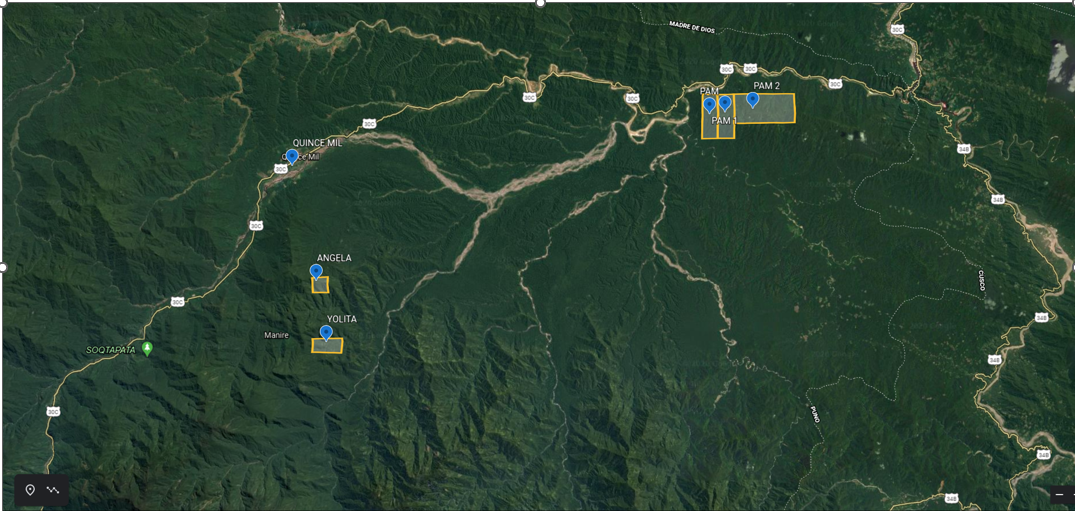
Map
Contact Seller
Please use the form below to contact the seller about this property: